Getting the right information for your MFA is important so you aren’t headed in the wrong direction. There is unfortunately a ton of misinformation on MFA degrees. This video provides trusted, accurate, up to date information.
Video Walkthrough
- Don’t include any artwork whose sole purpose is to practice a specific skill, like anatomy sketches and linear perspective practice drawings.
- MFA programs are not concerned with your technical skills.
- Technical skills are not important to demonstrate, and it won’t be emphasized in the programs either.
- Some schools require the edge of the canvas to be in the portfolio.
- For that reason, it’s best practice to always photograph with the edge of the canvas so you don’t have to reshoot later.
- Don’t wait until your portfolio is 100% finished to start your artist statement.
What is your #1 challenge for your MFA portfolio?
Click below to ask me and I’ll try to send you something useful!
- Any artwork that is created from a prompt that someone else designed, class assignments, etc. shouldn’t go into your portfolio
- Your MFA portfolio is essentially you writing your own prompts, not an assignment someone else gave you.
- Often getting started with the artist statement as you develop your portfolio is important because it can expose the gaps in your thinking.
- Avoid long text descriptions when you upload your portfolio, no one has time to read them!
Stop using generic advice
Even the best videos and resources out there only go so far. Eventually you will hit a wall, because your specific situation demands factors that isn’t considered in those resources.
Mentoring
Mentoring cuts out what’s not relevant, and concentrates your effort entirely into what will actually make a difference in your goals.
- Your MFA portfolio shouldn’t look like a patchwork quilt of random, one off artworks that have nothing to do with each other.
- You don’t need your portfolio to be super cohesive and focused on one theme, but there should be continuity in terms of the concepts behind your work.
- Many schools require that half of the portfolio has been made in the past year.
- In general, artwork that is older than 2 years is too old for your portfolio.
- Every school has a certain culture to it, and you want your portfolio to align with that.

- Variety of media is fine in an MFA portfolio, as long as there is an underlying cohesion to the work.
- Poor photos of your artwork will make or break your application.
- Don’t use the exact same portfolio for every school.
- Broad, vague, generic concepts in your artwork will cause your pieces to skim the surface of these topics and come across as watered down.
- Narrow down your concepts to be as specific as possible and do research that is in depth. (reading a few articles online won’t cut it)
Prof Lieu’s Tips

When I agree to write a letter of recommendation, I ask the student to send me a school list + deadlines. (once you write a letter, it’s not time consuming to upload it to another school)
One of the important things about letters is to make it as easy for your recommender as possible.
It drove me nuts when students would keep changing their school lists, so just be conscious of their time and do as much as you can for them.
Art Prof is a leading expert on art school portfolios
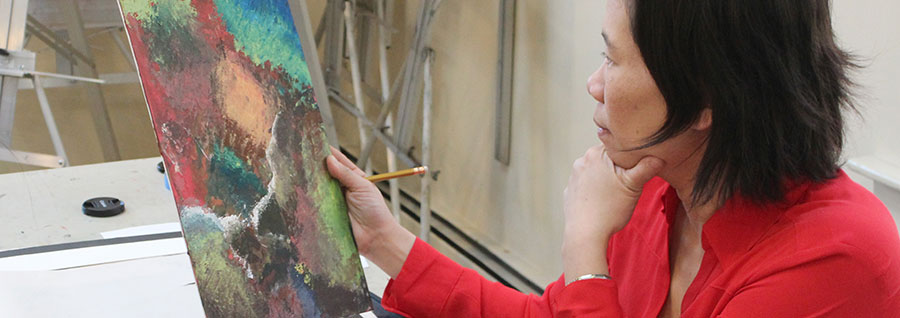
We’ve helped thousands of applicants create their best art school portfolio with our years of teaching at some of the best art schools in the US.
Be confident that you aren’t wasting time with things that don’t matter with our mentoring, portfolio critiques, statement editing, and resources.