
Artist statements are a process that can be really confusing and frustrating to write. If we were good at writing, we would have been writers!

However, artist statements are an important element of applications for an MFA, grants, residencies, exhibiting at galleries, and more. Many artists greatly underestimate the impact an artist statement can have on your application and professional presence.
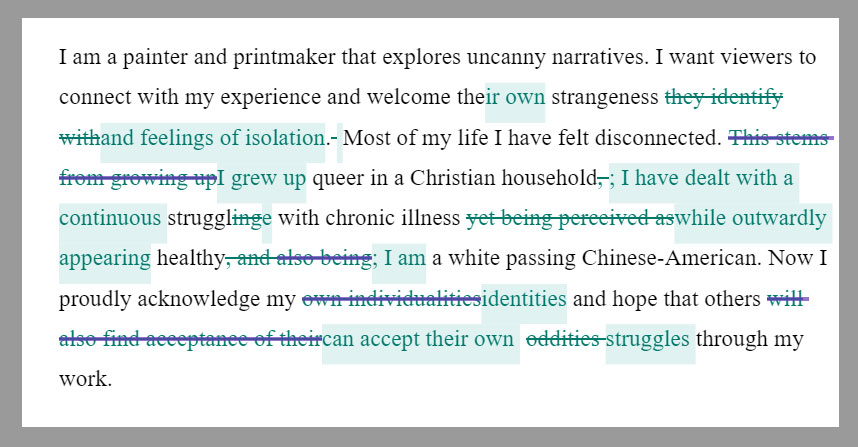
Overview

Types of Statements
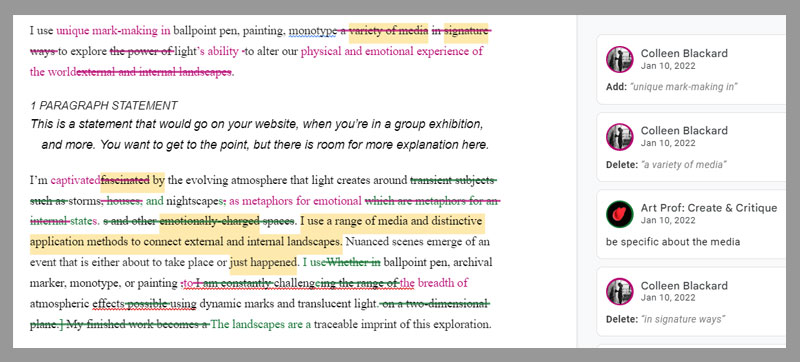
Writing Process

Sample Statements
Artist Statement Videos
See every stage of the process of writing a statement. You’ll see how ideation works, how to get started, how to approach revisions, and do refinements to create a professional presentaiton.
Write your best statement
Stop guessing in the dark about how to write your statement. Skip all the frustration and get fast answers on what your statement is missing, and what is bringing it down.
Prof Lieu does hands on editing on your statement so that you don’t have to. You’ll be confident that your statement addressing the critical elements that will make your statement and effective.
What to include
An effective artist statement should allow someone who knows nothing about your artwork (and who hasn’t seen your artwork) to get an overall sense of what themes you are exploring.
Talk about your motivation, perhaps a brief mention of what influences your studio practice, and insight into the format and materials you work with.
How long should my statement be?
Each context you place your artist statement in will require a different length.

When people read text online, unless they are reading a newspaper article, they tend to get overwhelmed by giant chunks of text. (there’s a reason why we have the term TLDR!)
Therefore, you’ll want to keep your artist statement on your artist website to a single paragraph.
Grants and residencies
Grant applications ask for a wide range of lengths, some will want two paragraphs, while others will allow you to write up to three pages. In general, these applications tend to ask for artist statements that are on the longer side.
This is one means by which you will be evaluated as an artist; it’s an important part of your application to show that you are serious and competent about your studio practice.
Statements for galleries
If you are attending an opening reception at an exhibition, chances are you might meet someone you’ve never met before, or a curator who you have met before who you would like to reconnect with.

You might only have a minute to remind someone of who you are, so have that elevator pitch ready to go!
What is your elevator pitch?

I was once at a luncheon at a liberal arts college, seated at a table with several new faculty who I had never met before. The faculty at the table were from all over the college, in various fields.

Naturally, as the conversations evolved, people asked about each other’s research.
You can’t go into a long rant about your artwork in a situation like this, (at least without looking like a selfish jerk) so once sentence is probably all you will get to explain what your artwork is like.
Gallery exhibitions
Galleries usually have a binder with information at the exhibition that has your CV, a price list, sometimes press clippings, and your artist statement.
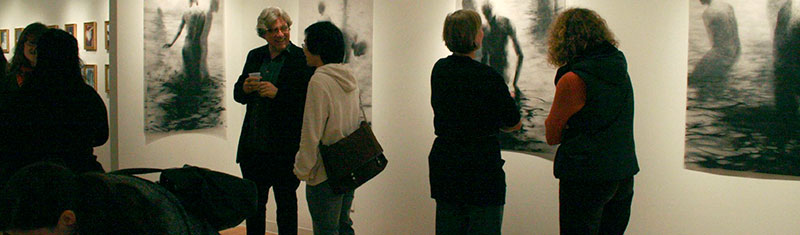
Your artist statement is an opportunity for your audience to read more extensively about your artwork in conjunction with the exhibition.

You can recycle your writing!
There’s no need to write a new artist statement from scratch for every new context you will be placing the statement in.
Keep the core of the statement consistent, and then make adjustments in terms of specific and length according to where the artist statement will be placed.
Initially, writing an artist statement can feel like a lot of work, but once you have a substantial one, it will become easy to tweak.

Statement formats
General statement
You’ll need an artist statement that covers all of your work in general, one that holistically explains your overall approach as an artist. Talk about themes and imagery that are always applicable no matter what specific project you are working on.
In terms of materials, you can mention general areas you work in, as opposed to going into great depth about your engagement with materials.
This is the version of you artist statement that you’ll want to have on your website, and that you an use as your elevator pitch in person.

Series Statement
Professional artists generally create individual bodies of artwork that center around one theme with a cohesive group of artworks in the same material and format.
Therefore, it makes sense to write an artist statement that addresses the specifics of that individual body of artwork. A statement like this is best suited to a gallery exhibition where you are presenting that body of artwork.

Focused paragraphs
Keep each paragraph concentrated on one aspect of your artwork.
For example, the first paragraph could outline the basic themes of your artwork, followed up by a second paragraph that goes into greater detail about the materials you work with.
If you jump all over the place, the statement will become fragmented and difficult for the reader to follow.
Keep your writing simple and straightforward, there’s no need to feel pressure to get super creative and experimental with the structure of your statement.
Get specific!
There’s a saying in journalism to “get the name of the dog.” Meaning that there’s a huge difference between writing “a brown dog” and “a brown dog named Rufus.”
Naming the dog makes it a specific dog, and gives the dog personality beyond a physical description.
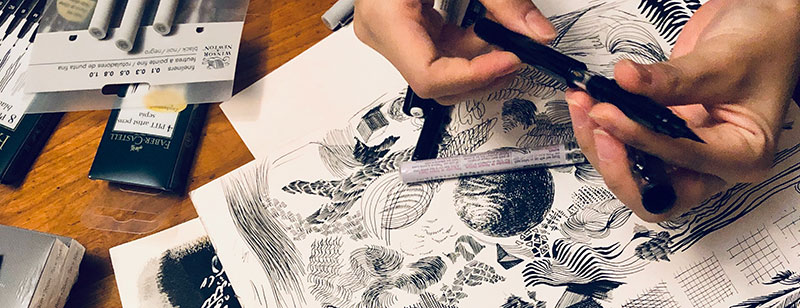
Your statement will be much more memorable if you get specific about what you discuss. Instead of saying that you do pen drawings, say that you draw with a quill pen and India ink on Bristol board.
Rather than state that you are a mixed media artist, explain that you use encaustic techniques that are constructed with found objects which are mounted on panels of wood.

Show confidence
Your artist statement is a way of presenting yourself as an artist to the public. Therefore, this isn’t the place to be self-deprecating. Avoid phrases like:
I’m trying to get better at…
I just learned this a month ago, and I’m not very good yet.
I hope that some day I will be able to….
It can be challenging to adapt a voice that is confident in your artist statement. So often, we are own worst critics and it can feel awkward to put ourselves out there in this way.
You’re not bragging either, you’ll simply explaining what your studio practice as an artist is all about.
First or third person?
Whether you choose first person or third person for your artist statement is completely up to you. Choose the option that you are comfortable with, although many artists will change to first or third person depending on the context of the statement.
First person
First person is usually seen as being slightly more casual than third person, it’s common to see artist websites where a narrative bio and/or artist statement is written in first person.
On social media, people usually write in first person given the casual nature of that context.
Third person
Third person is generally used for more formal contexts, such an artist statement that is in an exhibition catalog, or at a gallery exhibition.
Remember, there is no right or wrong when it comes to first person vs. third person, ultimately that choice is up to you!
Avoid art jargon
Puffed up, pretentious writing about art is everywhere. You don’t need to look up the longest words in the thesaurus to sound intelligent when writing about your work!
Use the words you already have, and focus on communicating your ideas. No amount of fancy vocabulary is going to help you.
“My artwork integrates bodily intercultural live encounters and eagages subjectively the effects of different discourses in contemporary electric, robotic techno-science.”
Don’t know what the sentence above means? Neither do we.
Start
Identify key words
If you are having trouble getting started, it helps to make a list of key words that relate to your studio practice.

You can use this list of key words as means of creating short phrases, which can then be filled into become complete sentences.
Word vomit
It’s tempting to want to judge your writing as you write, but try to avoid this! Sit down and just throw words and sentences down on paper.

Don’t try to be coherent, don’t adjust as you go, this will be disruptive and prevent you from getting your ideas out and onto the paper.
Write with very basic words, even if you feel like what you are writing seems like it could have been written by an elementary school student. You’ll come back and tweak later!
Step away and come back
Avoid the writing marathon, few people can sit down, write for 6 hours, and declare their piece finished at the end.
Instead, write an hour here, an hour there, you’ll be able to come back to your writing with fresh eyes and mistakes will be much easier to spot.
Edit your statement
The next best thing to getting professional edits, is to ask a friend who you think has decent writing skills. At the very least, they are another fresh set of eyes.
Even better, ask a friend who is not an artist, if they understand what you’re talking about, you’re probably in good shape!
Write your best statement
Stop guessing in the dark about how to write your statement. Skip all the frustration and get fast answers on what your statement is missing, and what is bringing it down.
Prof Lieu does hands on editing on your statement so that you don’t have to. You’ll be confident that your statement addressing the critical elements that will make your statement and effective.
Artist Statement Examples
One sentence statements
“My studio practice uses drawing, printmaking, and sculpture as means towards exploring the extremes of human emotion, using the human figure and face as a vehicle for expression.”
Prof Lieu


“Eloise’s work explores the intersection, mechanics, and deconstruction of power, politics and narrative.”
Eloise Sherrid

2 paragraph statement
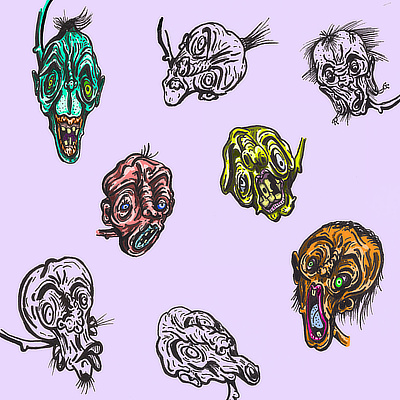
“Deepti has always been fascinated by the possibility of alien life. Often thinking about conspiracy theories and interplanetary warfare,
Deepti is drawn to themes of fear and anxiety, usually finding inspiration from her own set of fears. Her work is often colorful, character driven, and light hearted.”
Deepti Menon

“In Lauryn Welch’s paintings and installations, she explores how color and pattern are used on the body to express or conceal one’s identity in relation to one’s environment.
Her current body of work takes a split approach between body and landscape, and is heavily influenced by naturally occurring patterns. “
Lauryn Welch
Long statement, general studio practice
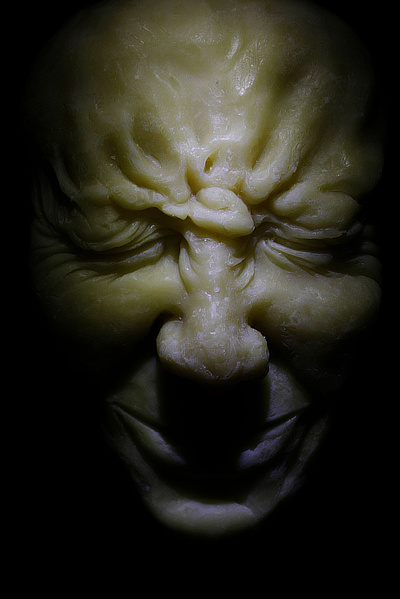
“‘Falling’ is a visualization of my personal experience with depression, as represented by a series of drawings, sculpture, and prints. The contemporary human experience, with its balance of awareness and repression of mental illness, provides both a context and a reason for this work to exist.
The human face, in its infinitely subtle range of emotional expression, has been explored throughout the history of art, and remains an irresistible subject.
The emotional spectrum surrounding the contemporary context of mental illness is broad, and although the topic has had increased awareness in the past several years, it remains largely a difficult topic for many.
Through the lens of my personal experience and with the visceral connection that art innately creates with its audience, I seek to open and foster a dialogue about mental illness; not from an objective distance, but from the understanding and intimacy of shared pain.
Depression and anxiety were frequent catalysts in my life for the loss of emotional and physical control. Unable to release myself from these episodes, I waited for the physical limitations of my body to end them.
I had been so accustomed to depression’s influence for such a long time that I could not distinguish the emotions and behaviors belonging to the illness from those of my own personality.
After struggling for many years without treatment, a diagnosis brought relief, and the process of unearthing myself from the disease began.”
The portrait drawings are created on Dura-Lar, which has been sanded by hand to create a textured, translucent surface. I smear tacky, thick etching ink onto the Dura-Lar with my hands.
After the etching ink dries, I add more definition with lithographic crayons, and scrape away highlights with an x-acto knife. Each portrait measures 48″ x 36.”
Prof Lieu
Long statement, specific body of work

“‘Emerge’ is a series of figure drawings that depict the long treatment process that began upon receiving a diagnosis. At the height of my depression, I was so deeply buried by the emotions that I could not separate myself from the disease.
During treatment, the depression gradually began to fade away. As the emotions slowly left, I started being able to see myself clearly for the first time in my life.
Contrary to my prior concerns about treatment, I felt more like myself than I ever had before. These drawings show this simultaneous process of the depression leaving as my true self emerges.
Even with ongoing treatment, improvements do not happen in a linear way. The process is unpredictable, continuous, and never ending. At times the emotions subside, on other days the depression is almost gone and occasionally it comes back in full force.
Even on my best days, the depression is always there to some degree. For this reason, the anguished figures in these drawings never completely disappear. These emotions will always be with me in some capacity for the rest of my life.
These large scale figure drawings are created on Dura-Lar, which has been sanded by hand to create a textured, translucent surface. I smear tacky, thick etching ink onto the Dura-Lar with my hands.
After the etching ink dries, I add more definition with lithographic crayons, and scrape away highlights with an x-acto knife. Each figure drawing measures 7′ x 4.’
The monotypes measure 24″ x 18″ and are printed on white Rives BFK paper. The figure sketches are drawn on 12″ x 9″ white charcoal paper with lithographic rubbing ink and a white plastic eraser.
Prof Lieu
Very long statement, specific body of work
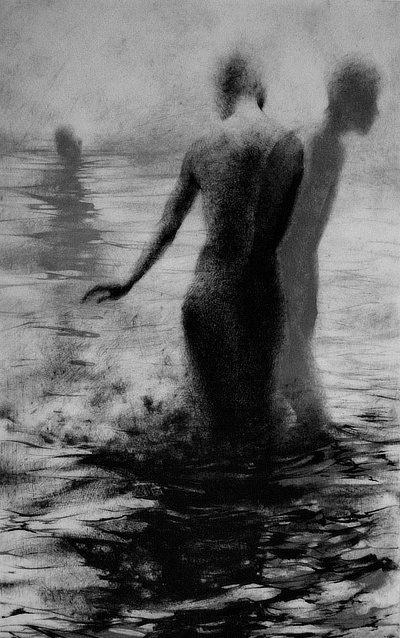
“I investigate ways to visually represent the emotional and physical experience of individual isolation. ‘Wading’ is an interdisciplinary project of related bodies of work involving various techniques of sculpture, drawing, and printmaking.
The objective of this project is to explore visual ways to represent the most severe form of isolation as loneliness that is experienced when physically surrounded by other people.
This is a specific form of loneliness that is involuntary and imposed upon by others, creating a state of discontent characterized by bitterness and a sense of punishment. It is the presence of others what can heighten and intensify the experience of loneliness for an individual.
The images in this project depict figure groups wading in water which become vehicles to visually articulating the experience of loneliness. Set within an infinite and undefined body of water, scenes of lost figures communicate moments of isolation between figures.
I portray loneliness as the experience of feeling unseen and unknown within a group. The figures all collectively occupy the same space, and yet are locked and isolated in themselves, unable to perceive the figures which physically surround them in the space.
These current drawings represent a process of working which involves multiple stages of development and various media. The process begins with figure sculptures which are created in order to serve as visual references for the drawing studies.
The figure sculptures are begun by the construction of armatures which become structural supports for the oil based plastilene clay which is applied to them.
Once the modeling process is completed, these figure sculptures are lit with natural light and carefully observed to facilitate the figures in the drawings. Preliminary drawing studies are made using direction observation from the sculptures, and later referenced in creating the final drawings.

The final drawings are executed with lithographic crayon on a sanded Dura-Lar surface, creating a coarse texture and surface in order to create suggestive, implied figures.
The drawings are then layered on top of each other; the translucency of the sanded Dura-Lar surface creating the illusion of ghost-like figures which exist in their own separate reality.
I work with an interdisciplinary approach which encompasses various techniques in drawing, painting, printmaking, and sculpture. New opportunities arise with every shift of medium, which allows for a significant amount of experimentation and spontaneity in the process despite careful preliminary plans.
Prof Lieu
Your best portfolio happens with expert answers
Find out fast what your portfolio is lacking, and what artworks could be bringing it down.
You family and friends mean well, but they are not experts and are likely giving you bad information.
Portfolio Critiques
Portfolio Critiques ensures you are getting expert guidance that gets you the right information quickly.


